

When Beckett announced its manga grading service in early 2024, the reaction was instant and unforgiving. Forums and social feeds erupted with insults, memes, and sharp verdicts like «cash grab» «pointless» «Americans don’t get it…». For many readers, the idea of sealing a manga inside acrylic felt like a betrayal of its very nature. For a medium historically rooted in accessibility, with volumes endlessly reprinted and passed from hand to hand, that shift felt unsettling.
The backlash was loud, yes, but it wasn’t random. It was the result of two collecting philosophies colliding head-on. To understand why, we need to take a quick step back.
The earliest signs of comic collecting and condition standards appeared in the 1970s. The legendary Overstreet Comic Book Price Guide, created by Robert M. Overstreet, became the de facto cataloging and pricing system for the U.S. comic industry and laid the groundwork for everything that followed. But the true turning point came later.
By the 1990s, collectors agreed that condition mattered, yet there was no shared language to define it. A seller might call a book “mint,” while a buyer would argue it was merely “very fine.” Disputes were constant, and with the rise of marketplaces like eBay, trust became the rarest commodity of all.

Published in several editions, the guide itself has received numerous variant covers over the years, turning it into a collectible item
Third-party grading companies, already well developed in the sports-card market, stepped into this uncertainty with a bold promise: a universal standard. They introduced the 10-point scale, authoritative labels, and, most importantly, the slab, a tamper-proof acrylic case that froze a comic in time.
The timing could not have been better. The late 1990s and early 2000s brought a speculative boom fueled by nostalgia, pop-culture hype, and an increasingly connected world made smaller by the internet. A 9.0 copy of Amazing Fantasy #15 – the first appearance of Spider-Man – became not just a prized collectible but a blue-chip investment expected to rise steadily in value. The market began revolving around “key moments”: Wolverine’s debut in Incredible Hulk #181, the death of Superman, Galactus and the Silver Surfer’s first appearance in Fantastic Four #48, or the rise of creator-owned titles like Spawn.
Grading turned pop-culture milestones into hard currency, and for many collectors, that was the thrill.
But this model was distinctly American. It thrived on a cultural obsession with first appearances, debuts, and historic turning points. Apply that logic to manga, however, and the cracks begin to show. The ecosystem of manga collecting has never mirrored the American system built on speculation, scarcity, ROI, and investment. And that historical framework brings us to the next question: what exactly should be graded in the world of manga and why?
CHOOSING WHAT TO GRADE
If the American market built its grading culture around icons like Batman, Superman, and Spider-Man, characters that have lived on for more than eighty years, manga presents a very different landscape. Japan has no true equivalent to these endlessly serialized heroes who anchor generation after generation. Manga series move relatively fast, their presence in mainstream culture is comparatively recent, and their lifespan is measured in years, not decades of perpetual reinvention. In other words: a young japanese manga fan in the 1970s read Osamu Tezuka, in the 1990s Slam Dunk, in the early 2000s Naruto, and today Jujutsu Kaisen.
So the question becomes almost inevitable: what are the long-standing “brands” of Japanese comics, the equivalents of those Western pillars that everyone recognizes, and that exist in quantities far scarcer than one might expect?
The answer isn’t a character at all. It’s the magazines.

Anthology magazines like Shonen Jump, Shonen Sunday, Shonen Champion and dozens more, are the true cultural monuments of manga. They have been published for fifty years or longer, shaping generations, discovering every major hit, and acting as the birthplace of the stories that later became global sensations. And because these tomes were treated as disposable after reading, their survival rate is shockingly low. In a twist of irony, the most iconic “brands” in manga are also some of its most perishable objects.
In the American comic world, collectors chase what they call “keys”: issues that introduce a major character, mark a pivotal moment, or define a franchise. Since the entire logic of grading was born in the United States, that framework inevitably bleeds into how grading is applied to manga. The instinct is the same: identify the moment something important entered the world, and preserve it.
And so, today, the items that get graded most frequently in the manga sphere follow that derivative but understandable pattern.
THE GOOD
Let’s step for a moment into the mindset of someone who loves grading.
For you, collecting means one thing: the best version of the rarest item, locked in, certified, documented.
You’re not just after rarity. Anyone can find a rare book if they dig enough. You want condition. You want the copy that makes other collectors pause their scrolling, the copy that shouldn’t exist because surviving three decades in flawless shape is basically a statistical miracle. And you enjoy that pursuit: the precision, the obsession, the bragging rights.
Sure, grading companies aren’t perfect. They make mistakes, their standards spark arguments, and sometimes… they fuck up. But here’s the thing: grading is the only universally recognized system we have. End of story. We’re long past the days where people debated whether grading mattered. The entire collectible world, cards, comics, toys, prints… is built on it now. It’s embedded in the collecting culture. You don’t have to respect the system, but you can’t pretend it isn’t the system.
And yes, value matters to you. Of course it does. Not because you’re planning to sell everything tomorrow, but because owning something important and valuable hits a very specific nerve. Call it pride, call it dopamine, call it whatever you want, everyone knows that rush you get when you realize your shelf is worth more than your car.

Naruto #1 (first print with obi) graded BGS 9.8, sold for 20.000$
You see manga grading in its infancy and you’re jumping in now, because getting in early is what smart collectors do. If the market evolves like cards or comics did, the people laughing today will be the ones paying tomorrow.
So when someone pipes up with «…but manga are meant to be read!!!», you can practically feel your eyes rolling out of your skull. You’re grading Japanese books you can’t even read, what exactly are you “ruining” here? And when they complain that manga get endless reprints, making grading “pointless,” you simply point out that Action Comics #1 has a perfect facsimile edition, yet the original still sells for millions of dollars, because it’s not the copies, nor later printings, that determine value, but how incredibly difficult it is to find an authentic copy in that condition.
For you, grading It’s how you separate the real finds from the flea-market clutter. It’s how you turn a cool object into a verified piece of history.
THE BAD
Now let’s switch lenses and step into the mindset of someone on the opposite end.
You’ve probably been collecting manga for years, long before slabs, serial numbers, and acrylic cases became part of the conversation. For you, the idea of locking a book behind plastic isn’t preservation, it’s sacrilege. These volumes are things you grew up with, handled, reread, lent, rediscovered. They’re memories, not museum pieces. Sealing them away feels like cutting off the very life they carry.
And you’ve seen this story before. You watched what happened to American comics: prices ballooning because a label said 9.8, entire runs distorted by speculation, newcomers priced out because a handful of people decided cardboard was the new gold. You’d hoped manga could escape that fate. Now that grading is creeping in, you can’t help but feel like the same machine is starting to rev up again.
For you, collecting should be accessible. It shouldn’t turn into a sport for rich speculators or crypto-kids cycling through hobbies like trends. Today it’s graded manga, yesterday it was sneakers, tomorrow it’ll be something else. And you’re tired of seeing every passion get swallowed by the same investment mindset.
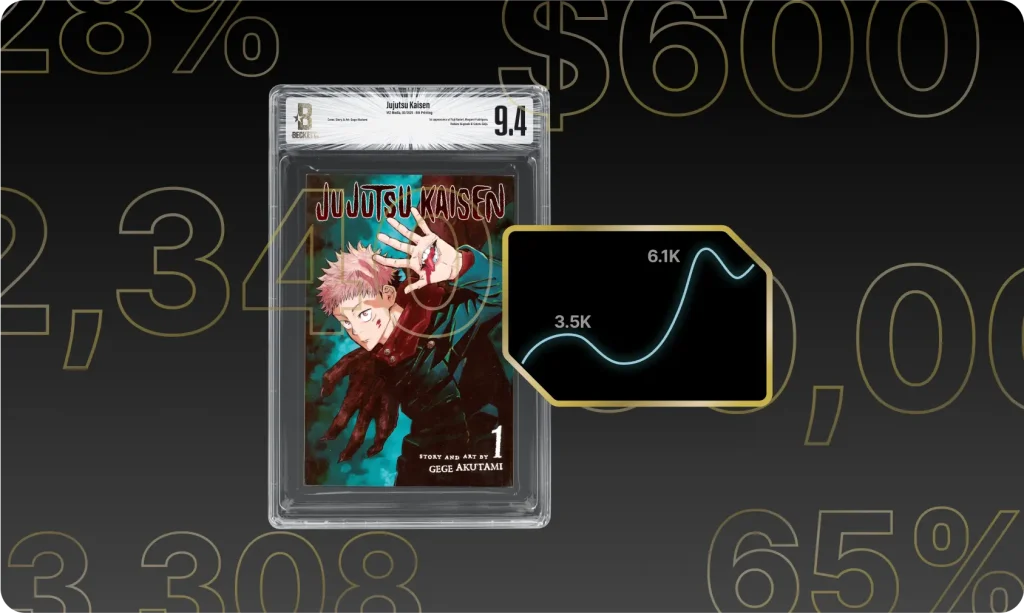
ROI, investment, POP numbers, graphs… do they really belong to the manga industry?
And honestly, you don’t need anyone to tell you the condition of your own books. You’ve been evaluating spines, pages, glue, and paper quality long enough to know exactly what you’re holding. Paying someone to put a number on it feels unnecessary at best, performative at worst. Even the supposed “preservation benefits” sound shaky to you. If sealing a book in plastic were truly the best way to preserve it, you’d expect rare manuscripts from the 1500s to be sitting in slabs by now. Guess what? Not even close.
But what bothers you most goes deeper than formats or prices. It’s the feeling that something meant to be read, shared, passed along, is being rerouted into yet another speculative market. That an art form built on accessibility and mass readership is slowly being pushed toward scarcity, elitism, and financial gatekeeping.
You don’t hate grading because you’re nostalgic or stubborn. You’re wary because you’ve seen what happens when collecting becomes commodified. And you don’t want manga – the medium that shaped your childhood – to become just another battleground for investors chasing the flavor of the month.
THE UGLY
Beyond the philosophical debate, there’s also a very basic, very visible problem: SIZE.
Manga and magazines come in wildly different formats, and when you place them inside a one-size-fits-all acrylic case, the result is often… ugly. Plain and simple.
American comics have been standardized since the 1970s. The same goes for trading cards like Pokemon or Magic, which all share identical dimensions (only Yu-Gi-Oh and a few others TCGs are slightly smaller, but by just a few millimeters).
Thanks also to their compact formats, cards and comics have managed to find a sweet spot between size, clarity, and elegance. Manga slabs haven’t. Not yet.
Yes, the oversized dimensions of magazines don’t help. But the real issue is industrial in nature. Cases are mass-produced, and at the moment there are essentially two production lines: one for tankōbon and one for magazines. Two rigid standards, each creating its own set of problems.
- When smaller formats, such as Jump Comics (JC) or Kodansha Comics (KC), are graded inside standard tankōbon slabs, the case completely overwhelms the book. The manga ends up floating in a sea of empty space, dwarfed by a frame that’s far too large.. Instead of highlighting the object, the slab buries it under layers of dead space inside a pure plastic overkill.
- Magazines, to be fair, fit their slabs more proportionally, since the empty centimeters are filled by publications that already have the size of medieval tomes. But this creates a different, equally obvious problem. Once slabbed, a Jump issue turns into a monstrosity: a heavy acrylic brick, awkward to handle, difficult to transport, and nearly impossible to place on a bookshelf without reorganizing your entire library.
My hope? That grading companies eventually learn to subtract instead of add. Lighter, slimmer, smarter designs; cases that are practical to handle and pleasant to look at, instead of turning manga into objects sealed inside plastic sarcophagus.
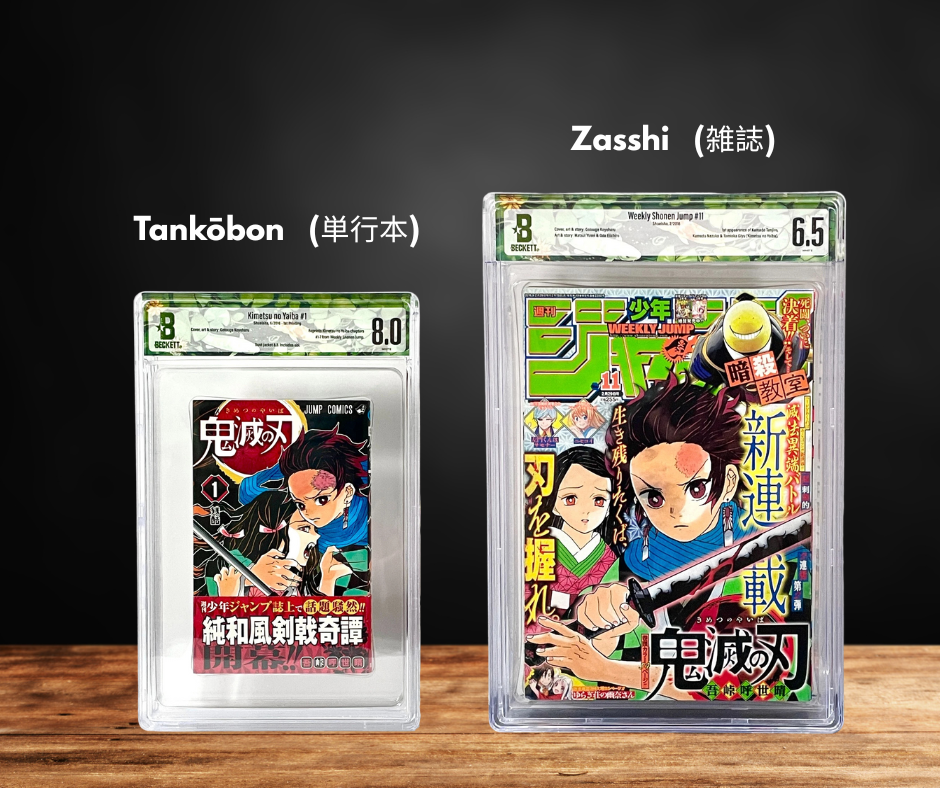
Too much empty space on the left… just too much of everything on the right
THE VARIANT DILEMMA
By now, there’s still one elephant in the room we haven’t touched: Japanese cover variants.
If today’s grading scene revolves around manga volumes and vintage magazines, printed in hundreds of thousands of copies, what happens when collectors start setting their sights on truly rare and limited items, like certain Japanese special covers?
Because American special editions like the Naruto #72 NYCC or My Hero Academia #1 SDCC exclusives are easy: they’re just regular softcover books. But Japanese variants? Those are a different species entirely. Most of them aren’t books at all, they’re standalone dust jackets slipped into magazines, handed out as store bonuses, or tucked into plastic sleeves at bookstores’ checkout. No binding, no spine, no “volume” to grade. Just a loose cover.
So what do you do with that?

This insanely rare cover of REAL, limited to 500 copies, was mailed inside an envelope. How on earth are you supposed to grade it?
Right now, the answer is simple: you don’t. Beckett and every other grading company avoid Japanese variants for one reason, there’s no standard way to encapsulate them. And sure, you could slab the entire magazine with the untouched bonus cover still folded inside, maybe even add a special note on the label. But let’s be honest: paying to seal a variant you can’t unfold, stuck inside a magazine you can’t open, inside a case you can’t crack… that’s not exactly peak collector logic.
And it gets worse. Some of the rarest lottery variants in Japan arrive folded in envelopes or rolled up like posters. As boundless as collector madness can be, it’s hard to believe anyone could grade simple sheets of paper, nothing more.
Officially, there’s still no solution, and maybe there never will be. But there is a possible path forward.
If you look at a graded japanese manga today, you’ll notice a separate score for the dust jacket. That score is treated almost as a separate matter and has very little impact on the final grade. What’s carefully inspected is the volume itself.
My proposal flips that system on its head: you mount the variant dust jacket onto the correct volume (when available), send it in, and have the jacket alone evaluated. Scratches, creases, discoloration, everything that actually defines the condition of the variant, without letting the base book affect the grade at all. Then you encapsulate it in a standard manga slab, maybe with a different label color so collectors can tell at a glance that this is a “variant-only” grade.
Clean, consistent, and doable… without reinventing the production line.

In normal circumstances, the dust jacket’s score has little impact on the final grade.
AFTER THE HYPE
Whether any of these solutions will ever be adopted is impossible to say. But one thing is certain: the market always moves toward demand. Manga grading was imported from the U.S., along with its habits, its priorities, and its obsession with turning collecting into an economy of its own. If enough collectors decide they want graded Japanese variants, the industry will eventually find a way to deliver.
But even putting variants aside, the conversation around manga grading could stretch on forever. There’s no universal “right” or “wrong” here. Speaking as someone who’s been collecting for years, I doubt I’d ever send one of my rare volumes to be sealed in acrylic.
At the same time, I have zero issue with the collectors who love the practice. Some chase preservation, some chase value, some chase the thrill of a pristine score. And that diversity is exactly what keeps this hobby alive.
If the rush toward grading is here to stay, I truly hope it goes hand in hand with a broader cultural understanding of manga itself. Comicbook grading was born and shaped in the U.S., within a system that set its own rules from day one. Manga grading is different: it borrows from a completely separate world, rooted in Japanese publishing culture, with its own conventions and a century-long history.
The market will ultimately decide what works and what doesn’t. But right now, too many items are being slabbed with no real reason to exist, clear proof of a near-zero understanding of the medium they come from (a sincere piece of advice: never, ever grade a first-print volume #1 without its obi).
Make no mistake: if the future of manga grading ever comes to exist, it will not be shaped by bored, wealthy outsiders with deep pockets and no cultural literacy. It will be shaped by those who truly understand, love, and respect this form of art.
Issenman P.